
How Do Local Storage Unit Prices by Size Compare Across Cities?
Storage unit prices by size range from $40 to $320 per month, based on square footage, city location, and climate control. A 5×5 unit averages $52 nationally, while a 10×30 unit averages $270. Prices in major metro areas run 25-45% higher than rural markets for the exact same size. This gap exists because of land cost, local demand, and how many facilities compete near you.
Most renters end up with the wrong size because they never measure their belongings before booking. This guide walks through real pricing data, size charts, and practical examples so you can budget with confidence. You’ll learn the exact square footage for every size tier, how climate control changes your bill, and what actually drives price differences between cities. Every section includes real-world examples so the numbers mean something, not just sit on a chart.
Storage unit prices by size, at a glance:
- Smallest unit (5×5): $40-$65/month, 25 sq ft
- Average unit (10×10): $95-$150/month, 100 sq ft
- Largest common unit (10×30): $220-$320/month, 300 sq ft
- Climate-controlled units cost 25-50% more at every size
- Metro area units cost 20-45% more than rural units of the same size
Storage Unit Price Breakdown By Size
| Unit Size | Square Footage | Comparable To | Average Monthly Price |
| 5×5 | 25 sq ft | Small closet | $40-$65 |
| 5×10 | 50 sq ft | Walk-in closet | $60-$95 |
| 10×10 | 100 sq ft | One-car garage | $95-$150 |
| 10×15 | 150 sq ft | Large bedroom | $130-$190 |
| 10×20 | 200 sq ft | Two-car garage | $160-$240 |
| 10×30 | 300 sq ft | Small warehouse bay | $220-$320 |
These figures reflect general U.S. pricing patterns. Rates near you may run higher in dense zip codes or lower in smaller towns, so treat this table as a starting point, not a final quote. You can browse current local rates and availability on Dhighway Storage before comparing sizes below.
What Is The Average Storage Unit Size
The average storage unit size rented across the country is 10×10 feet. This size fits most one-bedroom apartments or the overflow from a partial two-bedroom home. It’s the single most common size booked, since it strikes a balance between cost and usable space.
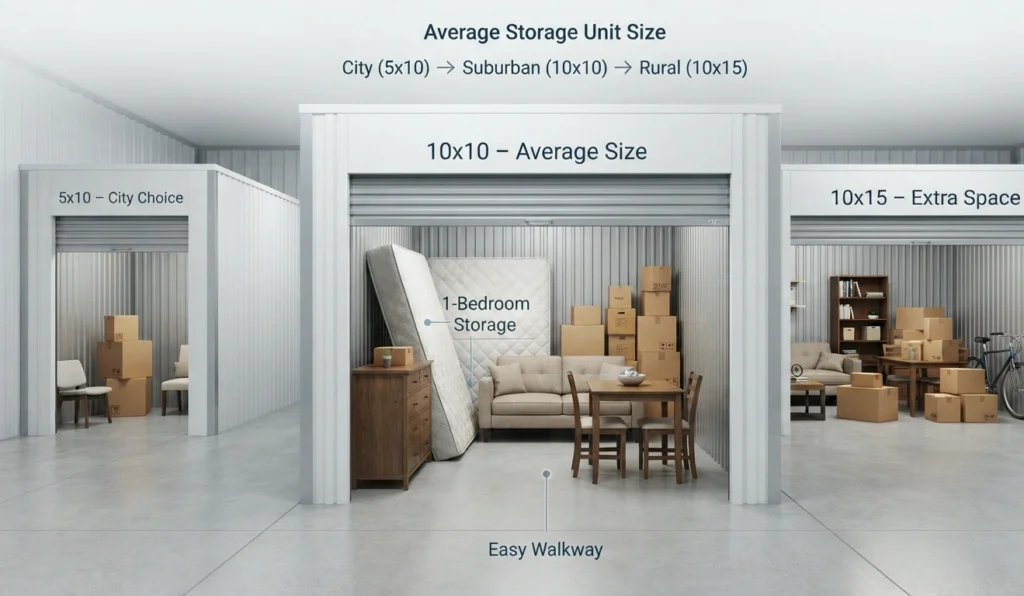
Example: Picture a renter moving out of a one-bedroom apartment with a queen bed, dresser, couch, dining table, and about 18 boxes. That inventory fits a 10×10 unit if stacked carefully, but a 10×15 gives room to walk in and grab something without unpacking half the unit.
Local density changes what “average” looks like in practice:
- Dense city centers: renters often downsize to 5×10 units since every extra square foot costs more
- Suburban areas: 10×10 and 10×15 units are the most booked sizes
- Smaller towns and rural areas: 10×15 and larger sizes are common, since price per square foot drops
How City Density Affects Average Size Choices
Storage facilities in crowded cities charge more per square foot, so renters naturally shift toward smaller units to control cost. In smaller cities with more available land, facilities can offer bigger units at a lower per-foot rate, which changes buying behavior entirely. This is why the “average” unit size for a renter in a major metro can look quite different from the average size booked in a mid-size town an hour away.
Smallest Size Storage Unit Options
The smallest size storage unit at most facilities measures 5×5 feet, about 25 square feet. Picture a small walk-in closet. This size is the cheapest option almost everywhere, usually priced under $65 a month.
What typically fits in a 5×5 unit:
- 10-15 medium moving boxes
- A small dresser or nightstand
- Seasonal decorations and holiday items
- Sports gear like skis, a golf bag, or a bicycle
Some facilities also carry smaller 5×3 locker-style units for documents or valuables. These often aren’t listed on the main pricing page, so a quick phone call to the front desk can turn up a cheaper option than what’s advertised online.
Biggest Storage Unit Size And When You Need It
The biggest storage unit size at most standard facilities is 10×30 feet, about 300 square feet, roughly the footprint of a small two-car garage. Monthly pricing for this size regularly tops $250 in busy metro areas and can climb toward $320 during peak moving months.
Real-world example: A family relocating out of a four-bedroom house with a full garage of tools, holiday decorations, and extra furniture usually needs this size or close to it. Small business owners storing pallets, tools, or seasonal inventory also land in this size range most often.
Before locking in a large, expensive unit, it helps to estimate storage unit size near you using a simple online tool based on your actual room count and item list. This one step prevents the most common and costly mistake: paying every month for 100 extra square feet you never touch.
Signs You Need The Largest Unit Available
- You’re storing the full contents of a home with 4 or more bedrooms
- You need room for a car, boat, or small trailer
- You run a business with bulk inventory, tools, or equipment
- You’re merging two households during a move or renovation
Climate Control Impact On Storage Unit Prices By Size
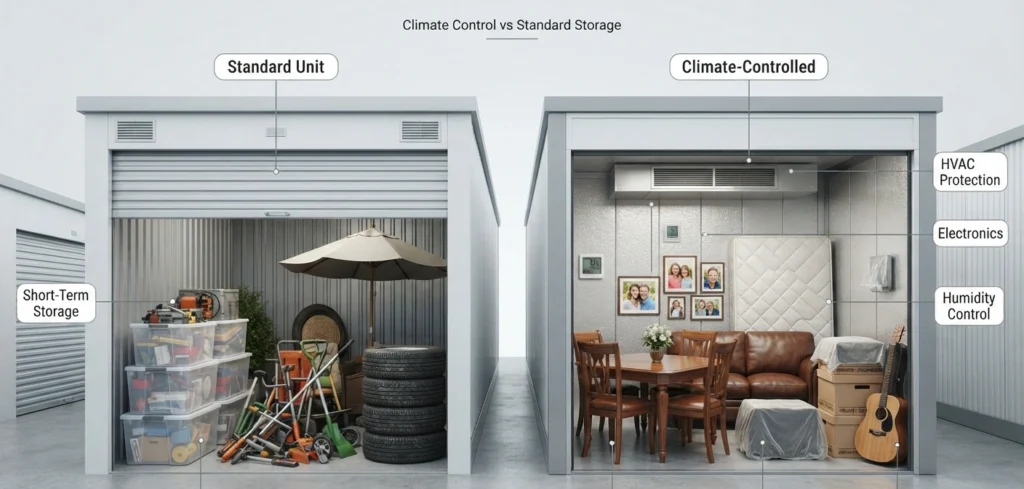
Climate-controlled units cost 25-50% more than standard units, no matter which size you pick. A standard 10×10 averaging $120 a month can jump to $155-$170 with climate control added. That premium pays for an enclosed building, tighter insulation, and HVAC systems that keep temperature and humidity steady.
When climate control is worth the extra cost:
- Wood furniture stored longer than six months
- Musical instruments, especially anything with strings or wood
- Photographs, old documents, or paper records
- Electronics like TVs, computers, or game consoles
- Leather furniture and fabric-heavy items like mattresses
When you can skip it and save money:
- Short-term storage under 90 days in a mild climate
- Plastic totes packed with non-sensitive items
- Metal tools or outdoor gear already built to handle weather
- Vehicles designed for outdoor exposure
Seasonal Price Swings By Region
Storage prices tend to climb 10-20% during peak moving season, which runs roughly May through September across most of the country. College towns see the sharpest jump in late August, tied directly to move-in and move-out weekends. Areas near military bases follow a similar pattern tied to summer relocation orders.
Booking between October and February usually locks in the lowest rates for any given size, since demand drops and facilities compete harder for renters. Planning a move two to three months ahead gives you real leverage to negotiate a better monthly rate or move-in special.
How To Choose The Right Size Without Overpaying
Sizing mistakes cost money in two directions. Too small means a stressful mid-lease upgrade or a second unit. Too large means paying for space you’ll never fill.
A simple, practical checklist:
- List every room’s furniture and rough box count
- Measure your three largest items, like a couch, mattress, or appliance
- Decide if you need drive-up access or space for a vehicle
- Compare climate-controlled pricing against standard pricing near you
- Read the lease closely, since some move-in discounts hide a rate jump after month three
Once you’ve nailed down your size, it’s worth taking a minute to estimate storage unit size near you before signing anything, so your budget matches your actual needs instead of a guess. When you’re ready to move forward, you can rent a storage unit with a size and price you’ve already confirmed.
Storing A Vehicle: Size And Price Considerations
Vehicle storage follows different sizing rules than household storage. A standard sedan needs at least a 10×20 unit for safe clearance, while trucks and SUVs often require a 10×25 or larger. Units marketed for vehicle storage also tend to include extra security features, like reinforced roll-up doors.
Clearance matters more than most people expect. Parking too close to the walls risks door dings every time you get in or out, and tight spacing makes it harder to check fluids or run basic maintenance. Reading up on what size storage unit for a car offers the safest protection before signing a lease can save you from avoidable damage down the road.
Local Price Variance: What Actually Drives The Difference
Storage prices vary from city to city for three clear reasons: land cost, how many facilities compete in the area, and local demand cycles. Cities with limited storage supply near residential neighborhoods often charge premium rates no matter the unit size. This holds true even comparing two identical 10×10 units in different zip codes of the same metro area.
Other regional factors that move prices:
- Nearby universities or military bases increase turnover and demand
- High-rent residential areas push storage prices up as overflow space gets scarce
- New facility construction in an area can lower prices temporarily through competition
- Older facilities without climate control often price below newer competitors nearby
Checking three or more nearby facilities, instead of accepting the first quote you see, often reveals a $20-$40 monthly difference for the exact same size unit.
FAQs
Is a 10×10 storage unit big enough for a one-bedroom apartment?
Yes, a 10×10 unit holds the contents of most one-bedroom apartments, including a bed, couch, dresser, and 15-20 boxes. If you own oversized furniture like a sectional sofa, sizing up to a 10×15 gives more comfortable clearance.
Do storage unit prices change based on floor level?
Yes, ground-floor, drive-up units typically cost 10-15% more than upper-floor units that require elevator access. This reflects the convenience of loading and unloading directly from your vehicle.
Can I switch to a smaller unit after renting a larger one?
Yes, most facilities allow size changes with about 30 days notice, based on standard lease terms. Downsizing after you’ve settled in and decluttered is one of the easiest ways to lower a monthly bill.
Is climate control necessary for short-term storage under three months?
No, storage periods under three months rarely need climate control unless you’re storing electronics, instruments, or paper documents. Standard units handle general household goods just fine over a short window.
Conclusion
Storage unit prices by size come down to three things you can actually control: the exact square footage you choose, the local market you’re renting in, and whether you add climate control. Cities with tighter storage supply near residential areas charge more for identical square footage than markets with more available inventory. Measuring your belongings honestly before renting, instead of guessing a size, remains the single best way to avoid the two most common and costly mistakes. Seasonal timing and floor-level access also shift your final monthly cost more than most first-time renters expect.
Comparing several nearby facilities, not just whichever one shows up first in a search, gives you real leverage on both price and lease terms. Smaller units under $65 a month work well for light, seasonal storage, while larger garage-style units suit full household moves or vehicle storage. Climate control adds real cost, but it protects specific high-value items in a way that pays for itself over time. Using these size and pricing benchmarks before you sign a lease keeps your storage budget predictable and firmly in your control.